Why Defense Platforms Are Moving Toward Rugged Edge AI Architectures
The Growing Role of Rugged Edge AI in Defense Systems
Modern defense operations are generating more data than ever before. From ISR platforms and unmanned systems to radar arrays and electronic warfare sensors, today’s military environments depend on the ability to process and analyze massive streams of information in real time.
The challenge is no longer data collection—it is turning that data into actionable intelligence at mission speed.
Traditional defense computing architecture relied heavily on centralized processing or reach-back systems, where sensor data was transmitted to remote command centers or cloud infrastructure for analysis. While effective in earlier operational environments, these models are increasingly misaligned with modern mission requirements.
Today’s defense missions demand:
- Faster response cycles
- Higher autonomy
- Operation in disconnected or contested environments
- Real-time situational awareness at the edge
This shift is driving a fundamental architectural transition toward rugged edge AI systems capable of processing intelligence directly at the point of data generation.
Why Traditional Defense Architectures Are No Longer Enough
Legacy defense computing systems were built around centralized intelligence models. Data collected from airborne, naval, or ground platforms was transmitted to remote systems for processing and decision-making.
However, modern operational environments have changed significantly.
Today’s defense systems operate under conditions defined by:
- High-resolution multi-modal sensors
- Massive RF and telemetry data streams
- Autonomous and semi-autonomous platforms
- Distributed battlefield networks
- Intermittent or denied communications
Key limitations of centralized architectures:
Latency Constraints
Delays introduced by remote processing can directly impact mission effectiveness and situational awareness.
Bandwidth Saturation
Modern sensors generate data volumes that exceed efficient transmission capabilities in real time.
Operational Fragility
Communications links are increasingly vulnerable to jamming, degradation, or total loss.
System Complexity
Distributed compute pipelines increase integration overhead and lifecycle cost.
These challenges are driving a shift toward local, edge-based intelligence processing.
The Rise of Edge AI in Defense Systems
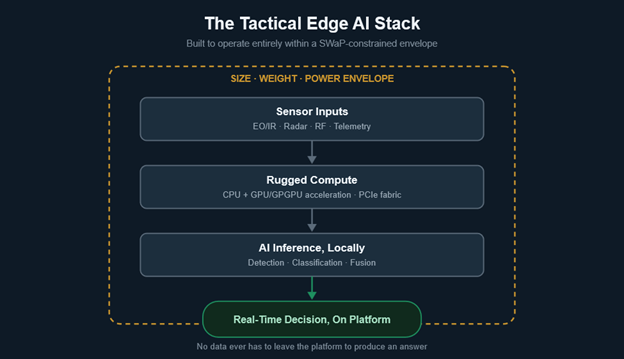
Edge AI refers to the deployment of artificial intelligence and accelerated computing directly on embedded systems operating at the tactical edge.
Instead of transmitting raw data to centralized infrastructure, edge AI systems process information locally in real time.
This enables:
- Reduced latency decision-making
- Improved operational responsiveness
- Independence from continuous connectivity
- Real-time situational awareness
- On-platform autonomous intelligence
This shift is redefining how defense systems are designed—moving intelligence closer to the mission environment itself.
Why Ruggedization Is Critical for Edge AI
Unlike data centers or commercial environments, defense platforms operate under extreme conditions, including:
- Shock and vibration
- Wide temperature variation
- Dust, humidity, and moisture exposure
- Power instability
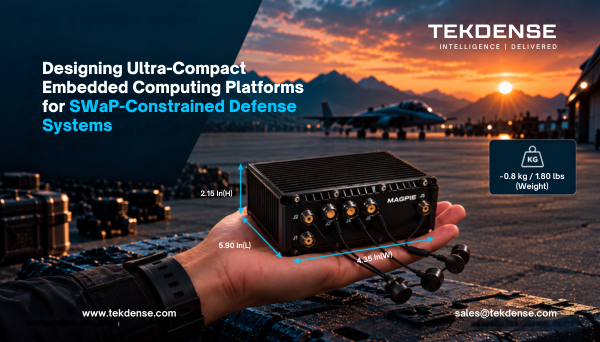
- SWaP-constrained platforms
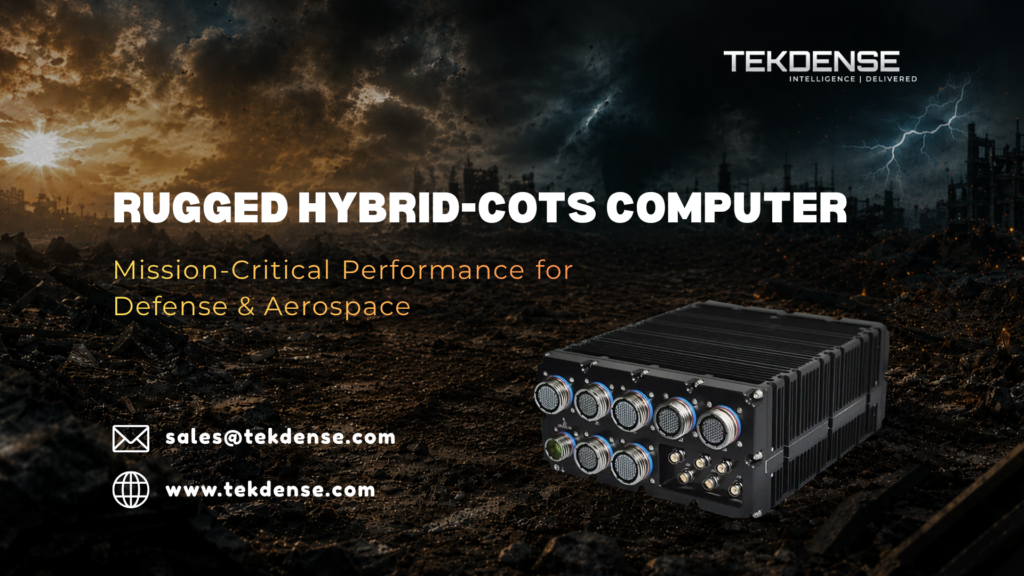
Edge AI systems deployed in these environments must combine high compute performance with environmental resilience.
At the same time, defense platforms impose strict Size, Weight, and Power (SWaP) constraints, particularly in:
- Unmanned aerial systems (UAS)
- Armored ground vehicles
- Naval embedded systems
- Mobile command platforms
This requires compact architectures capable of delivering high-density compute performance within rugged, constrained enclosures.
AI Workloads Driving Defense Edge Computing
Modern defense platforms increasingly depend on AI to support mission-critical functions.
ISR and Sensor Fusion
Multi-sensor fusion combining EO/IR, radar, RF, and telemetry enables real-time target detection, classification, and tracking directly onboard platforms.
Autonomous Navigation
Unmanned systems require onboard intelligence for navigation, obstacle avoidance, and decision-making in GPS-denied environments.
Electronic Warfare and RF Spectrum Analysis
AI acceleration enables fast classification of signals, threat detection, and spectrum awareness in contested electromagnetic environments.
Predictive Maintenance
Real-time monitoring of system health enables early detection of failures and improved operational readiness.
Mission Decision Support
AI systems help operators filter large volumes of data and prioritize critical threats and events.
These workloads demand significantly higher parallel compute capabilities than traditional CPU-only architectures can deliver.
Accelerated Computing at the Tactical Edge
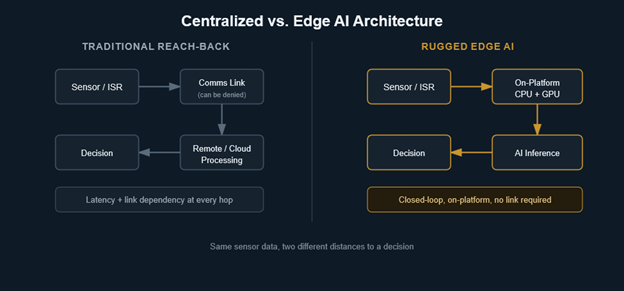
To meet these requirements, defense platforms are increasingly adopting heterogeneous computing architectures combining CPUs with GPU and AI accelerators.
GPUs are particularly suited for:
- Parallel processing
- Computer vision
- AI inference
- Signal processing
Modern rugged edge AI systems commonly integrate:
- GPU/GPGPU acceleration
- High-speed PCIe-based architectures
- Modular embedded computing standards
- High-bandwidth networking fabrics
- Real-time mission computing stacks
This enables consolidation of sensing, processing, and mission intelligence into compact, deployable systems.
The result is:
- Faster decision cycles
- Reduced system complexity
- Higher compute efficiency at the edge
The Importance of Modular Open Architectures
As defense systems evolve, modularity and interoperability are becoming essential design principles.
Standards such as MOSA, SOSA, and VNX+ are enabling next-generation defense computing architectures by:
- Reducing vendor lock-in
- Improving system interoperability
- Simplifying integration and upgrades
- Accelerating prototyping cycles
- Lowering lifecycle costs
Modular architectures allow defense systems to evolve incrementally rather than requiring full platform redesigns.
Tekdense and Modular Edge AI Systems
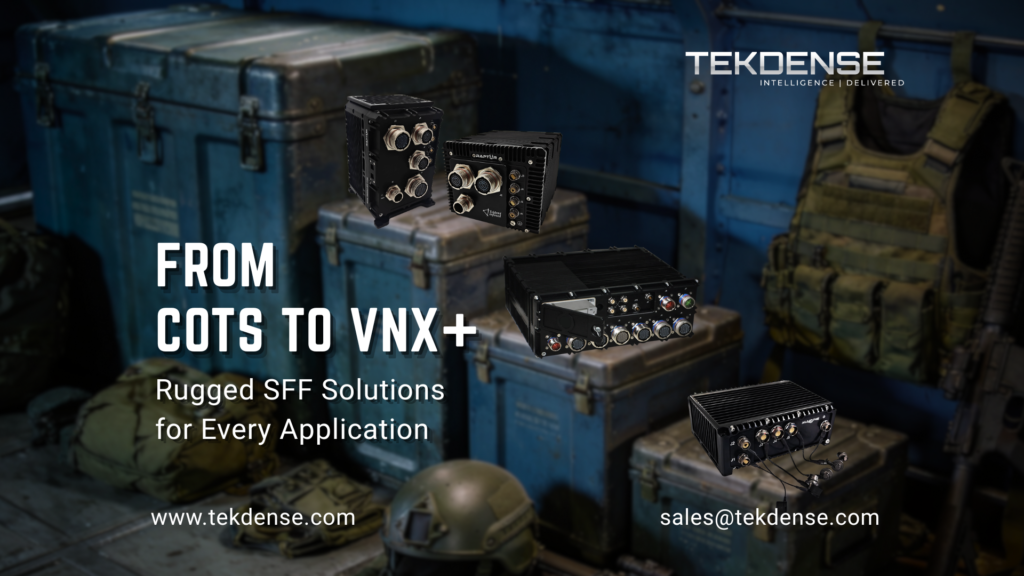
Tekdense enables modular edge AI systems for defense platforms built around open and scalable embedded computing architectures, including VNX+ (VITA 90), MOSA, and SOSA frameworks.
This approach supports next-generation defense computing by enabling:
- Modular integration of compute, I/O, and acceleration subsystems
- Interoperability across heterogeneous defense platforms
- Reduced system integration complexity
- Scalable deployment of real-time edge AI workloads
By leveraging modular architectures, defense systems can adapt to evolving mission requirements while maintaining long-term platform flexibility.
The Future of Rugged Edge AI
The future of defense computing is being shaped by distributed intelligence and autonomous mission systems.
Key trends include:
- Increased platform autonomy
- Real-time multi-sensor fusion
- AI-assisted mission decision-making
- Edge-native system architectures
- Distributed battlefield intelligence networks
At the same time, SWaP constraints and harsh operational environments will continue to drive innovation in rugged embedded computing systems.
Edge AI is no longer an emerging capability—it is becoming a core requirement for next-generation defense platforms.
Conclusion
Defense systems are undergoing a fundamental transformation driven by the need for real-time intelligence, autonomy, and operational resilience.
Traditional centralized computing architectures can no longer meet the demands of modern sensor-heavy, distributed, and contested environments.
Rugged edge AI architectures address this gap by bringing accelerated computing directly to the tactical edge—enabling faster decision-making, reduced latency, and mission-critical reliability in the field.
As defense platforms continue to evolve, edge AI will play a foundational role in shaping the next generation of intelligent, autonomous, and mission-ready systems.
Contact Tekdense for Rugged Edge AI Solutions
Tekdense provides a comprehensive portfolio of rugged embedded computing solutions, including AI edge embedded computers, VNX+ (VITA 90) systems and modules, GPU acceleration modules, rugged servers, and embedded networking solutions designed for mission-critical defense applications. Reach out to us at sales@tekdense.com or visit www.tekdense.com to explore the right solution for your edge AI deployment.