Modern defense and aerospace platforms increasingly demand more computing capability from systems that must fit into smaller, lighter, and power-constrained spaces. From an embedded computer inside a UAV to a mission computer integrated into a vehicle electronics bay, the computing platform must deliver reliable processing while operating within strict mechanical, thermal, power, and environmental constraints.
This engineering challenge is commonly described as SWaP — Size, Weight, and Power.
A SWaP-optimized embedded computer is therefore not simply a smaller commercial PC. It requires careful integration of the processor, memory, storage, I/O, power architecture, cooling approach, enclosure, and expansion interfaces within a defined mechanical and thermal envelope.
The Magpie micro embedded computer platform, available in Magpie A and Magpie T configurations, is designed around these requirements. Built using an open COM Express (COMe) architecture and a compact rugged enclosure, the platform combines embedded processing, standard I/O, expansion capability, conduction cooling, and a 28 VDC power interface in a small form factor.
Why SWaP Matters in Embedded Defense Systems
Size, weight, and power are closely interconnected in deployed embedded systems.
Size determines where the computing platform can be installed. Space may be limited inside UAV fuselages, vehicle electronics bays, sensor pods, robotic platforms, or other mission equipment.
Weight directly affects the overall payload budget of mobile platforms. Reducing the weight of computing hardware can create additional payload capacity for sensors, communications equipment, batteries, or other mission equipment.
Power affects more than electrical consumption. Power consumed by the processor and other system components ultimately becomes heat that must be removed from the enclosure. Therefore, power efficiency has a direct relationship with thermal design, cooling requirements, enclosure size, and system reliability.
The engineering objective is not simply to minimize one parameter, but to achieve an appropriate balance between processing capability, power consumption, thermal performance, mechanical size, and required I/O functionality.
Engineering the Magpie Micro Embedded Computer
The Magpie platform is designed as a rugged Small Form Factor (SFF) embedded computer for applications where computing capability must be integrated into a compact mechanical envelope.
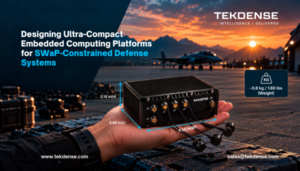
In its standard configuration, the platform measures approximately 150 × 110 × 54 mm (5.90 × 4.35 × 2.15 inches) and weighs approximately 0.8 kg (1.80 lb), ±2%. Actual dimensions and weight can vary depending on the selected build options and expansion configuration.
The platform uses an open COM Express architecture, allowing the processing platform and carrier/I/O architecture to be developed as modular elements. This approach provides a practical path for supporting different processor configurations within a common embedded system architecture.
Magpie A and Magpie T use different processor configurations while maintaining a common compact platform concept, allowing system designers to select the appropriate balance of compute capability and power consumption for their application.
Two Processing Options for Different Mission Profiles
One of the key advantages of the Magpie platform is the availability of two processor configurations.
Magpie A — Efficient Edge Processing
Magpie A is based on the 7th Gen Intel® Atom® x7835RE, an 8-core processor operating at 1.30 GHz, combined with 16 GB LPDDR5 memory at 4800 MT/s.
Its processing architecture includes Intel UHD Graphics, Intel DL Boost, Intel AVX2, and INT8 support with OpenVINO toolkit integration, making the configuration well suited to applications such as edge AI, computer vision, robotics, and distributed sensor processing.
Magpie A operates within a specified 20–25 W power range, configuration dependent and without expansion boards.
This makes Magpie A particularly relevant where processing capability needs to be balanced against a constrained power and thermal budget.
Magpie T — Higher General-Purpose CPU Performance
Magpie T is based on the 11th Gen Intel® Core™ i7-1185GRE, a 4-core processor operating at 1.8 GHz, with 16 GB LPDDR4 memory.
The Core i7-based configuration provides a higher-performance general-purpose computing platform for applications where CPU processing capability is a primary requirement.
Magpie T operates within a specified 20–30 W power range, also configuration dependent and without expansion boards.
The choice between Magpie A and Magpie T therefore becomes an application-level engineering decision: Magpie A emphasizes efficient edge processing and AI-oriented workloads, while Magpie T provides a higher-performance Core i7 processing platform for demanding general-purpose embedded workloads.
Thermal Management: Conduction Cooling Without a Fan
Thermal management becomes particularly important when high-performance computing is deployed inside a compact enclosure.
Magpie uses a fanless conduction-cooled architecture, transferring heat away from the electronic components through the mechanical structure rather than relying on forced-air cooling. This eliminates fan-related moving parts and can simplify thermal integration in rugged embedded installations.
Both Magpie configurations are specified for an operating temperature range of -40°C to +55°C. Operation up to +71°C is specified for appropriate configurations with assisted airflow. The storage temperature range is -40°C to +85°C.
The conduction-cooled approach is particularly useful when system designers need to minimize moving parts and integrate the computer into compact equipment where conventional fan-based cooling is difficult to implement.
At the system level, however, thermal performance remains dependent on the installation environment, chassis integration, workload, configuration, and available heat-transfer path.
Power Architecture for 28 VDC Embedded Platforms
Defense and aerospace platforms frequently operate from nominal 28 VDC power architectures. Magpie is designed around a 28 VDC input with a configuration-dependent power envelope.
Magpie A is specified at 20–25 W, while Magpie T is specified at 20–30 W, excluding expansion boards.
This relationship between power consumption and processing capability is an important consideration when selecting an embedded computer.
A higher-performance processor may provide additional computing capability, but it also increases the available thermal and power budget that must be considered during system integration. Conversely, an efficient processor configuration can be advantageous when the system is distributed across multiple sensor or processing nodes and power availability is constrained.
The Magpie platform is specified for MIL-STD-704F / MIL-STD-1275D power-related compliance, alongside its environmental and EMI compliance specifications.
I/O Connectivity and System Integration
Embedded computers rarely operate as isolated processing devices. They form part of a larger system connecting sensors, displays, communications equipment, storage devices, control interfaces, and other mission electronics.
Magpie provides a standard I/O set that includes:
- 1 × Gigabit Ethernet
- 1 × USB 3.2
- 2 × USB 2.0
- 1 × audio interface
- 4 × configurable serial interfaces supporting RS232/RS422/RS485
- 4 × GPIOs
- 1 × DisplayPort
The platform uses MIL-standard connectors for system-level connectivity.
This combination allows the computer to interface directly with a range of embedded peripherals without requiring a separate general-purpose I/O chassis for every application.
The serial and GPIO interfaces are particularly useful for embedded equipment that combines modern high-speed processing with legacy or deterministic control and instrumentation interfaces.
Modular Expansion for Application-Specific Requirements
A rugged embedded computer cannot rely on desktop-style expansion after deployment. The required I/O and functionality must generally be considered during system definition.
Magpie provides:
1 × mPCIe + 2 × mPCIe / Acropack® expansion sites
with I/O options defined and factory configured according to the selected build.
This expansion architecture allows the base platform to be adapted for different mission requirements while retaining the same compact embedded-computing concept.
Depending on the application configuration, expansion can be used to integrate additional storage, communications, or application specific I/O functionality.
Storage and Memory Options
Memory and storage configuration are also important when deploying an embedded computer for sensor processing and mission applications.
Magpie A provides 16 GB LPDDR5 memory at 4800 MT/s, with 32 GB eMMC specified and additional 64 GB to 512 GB MLC/SLC expansion storage options.
Magpie T provides 16 GB LPDDR4 memory, with up to 64 GB eMMC and 64 GB to 512 GB MLC/SLC expansion storage options.
The availability of non-volatile storage options enables the platform to support applications that need local operating-system storage, application data, sensor data, or mission software.
Ruggedization and Environmental Design
Embedded computers deployed in defense and aerospace systems can experience shock, vibration, temperature extremes, electromagnetic interference, and demanding power conditions.
Magpie is specified for compliance with:
- MIL-STD-810F
- MIL-STD-461F
- MIL-STD-704F
- MIL-STD-1275D
and uses MIL-standard connectors.
These specifications address important aspects of environmental, electromagnetic, and power-interface requirements for rugged embedded deployments.
For a specific program, the applicable test methods, configurations, operating conditions, and qualification requirements should be reviewed against the system-level compliance matrix.
Typical Embedded System Architecture
A typical deployment can be viewed as a processing chain:
Sensors → Embedded Computer → Local Processing → Networking → Mission System → Operator
The embedded computer can receive data from cameras, sensors, instrumentation, communications interfaces, or other subsystem electronics. Processing can then be performed locally before relevant information is transferred to another mission subsystem.
This architecture can reduce the need to send all raw sensor data to a centralized computing resource. Local processing can instead be performed close to the data source, depending on the application architecture and processing requirements.
For edge AI and computer-vision applications, this approach can be particularly valuable because inference can be performed close to the sensor rather than transferring all raw data across the platform network.
Designing for SWaP: More Than Just a Small Enclosure
A small enclosure alone does not make an embedded platform SWaP optimized.
A complete SWaP design must consider:
Mechanical envelope
The computer must fit within the available installation space while maintaining appropriate mounting and thermal interfaces.
Power consumption
The processor, memory, storage, and expansion modules must operate within the available electrical budget.
Thermal path
The heat generated by the electronics must be transferred effectively to the surrounding structure or cooling system.
I/O density
The platform must provide the interfaces required by the mission without introducing unnecessary external electronics.
Environmental capability
The system must operate within the temperature, environmental, electromagnetic, and power conditions of the target platform.
Expansion and lifecycle
The architecture should provide enough flexibility to accommodate application specific I/O and future configuration requirements.
Magpie addresses these considerations by combining a compact mechanical envelope, fanless conduction cooling, 28 VDC operation, standard embedded I/O, modular expansion, and two processor configurations.
Selecting the Right Magpie Configuration
The choice between Magpie A and Magpie T should be driven by the actual workload and system constraints.
| Requirement | Magpie A | Magpie T |
| Processor | 7th Gen Intel Atom x7835RE | 11th Gen Intel Core i7-1185GRE |
| CPU cores | 8 | 4 |
| Memory | 16 GB LPDDR5, 4800 MT/s | 16 GB LPDDR4 |
| Power envelope* | 20–25 W | 20–30 W |
| AI-oriented features | DL Boost, AVX2, INT8, OpenVINO | Core i7 general-purpose processing |
| Graphics | Intel UHD Graphics | Intel UHD Graphics |
| Standard I/O | GbE, USB, DisplayPort, serial, GPIO, audio | GbE, USB, DisplayPort, serial, GPIO, audio |
| Expansion | 1 × mPCIe + 2 × mPCIe / Acropack | 1 × mPCIe + 2 × mPCIe / Acropack |
| Cooling | Fanless conduction cooled | Fanless conduction cooled |
| Best suited for | Efficient edge AI, vision, robotics and distributed processing | Higher-performance general-purpose embedded computing |
*Power is configuration dependent and specified without expansion boards.
The table should not be interpreted as a benchmark comparison. Actual application performance depends on the software workload, operating system, algorithms, memory usage, storage configuration, and expansion hardware.
Applications in SWaP-Constrained Platforms
The combination of compact size, embedded processing, standard I/O, expansion capability, and rugged design makes the Magpie platform suitable for a range of space- and power-constrained embedded applications.
Unmanned Aerial Vehicles
Magpie can be considered for onboard computing tasks such as sensor preprocessing, computer vision, telemetry processing, and edge AI workloads where payload volume and power are constrained.
Unmanned Ground Vehicles
The platform can support embedded computing functions such as navigation, sensor processing, machine vision, control interfaces, and autonomous-system workloads.
Intelligence, Surveillance and Reconnaissance
Compact embedded computers can be deployed close to sensors for local processing of imagery and other sensor data before information is transferred to higher-level mission systems.
Mission Computing
The combination of processor capability, networking, serial interfaces, GPIO, display connectivity, and expansion makes the platform suitable for compact mission-computing architectures.
Industrial and Mobile Embedded Systems
The compact rugged form factor and conduction-cooled architecture can also be relevant to mobile and industrial systems where space, power, and environmental conditions constrain conventional computing platforms.
The Future of Edge Embedded Computing
As defense and aerospace systems continue to distribute computing closer to sensors and mission equipment, embedded computers are increasingly required to deliver more processing capability within smaller power and mechanical budgets.
Three trends are particularly important:
Edge AI: Processing and inference are increasingly moving toward the sensor or edge node, reducing the need to transfer all raw data to a centralized processor.
Performance-per-watt: Processor selection increasingly focuses on achieving the required workload performance within a defined thermal and electrical budget.
Modular architectures: Open architectures such as COM Express provide a path for processor and platform evolution without requiring every element of the system architecture to be redesigned.
Magpie A reflects the edge-AI trend through its Intel DL Boost, AVX2, INT8 and OpenVINO capabilities, while the Magpie T configuration provides an Intel Core i7-based platform for applications requiring higher general-purpose CPU processing capability.
Why Magpie Fits SWaP-Constrained Embedded Systems
Designing an embedded computer for defense and aerospace applications requires balancing multiple engineering constraints rather than optimizing a single specification.
The Magpie platform combines:
- A compact 150 × 110 × 54 mm standard mechanical envelope
- Approximately 0.8 kg / 1.80 lb standard weight
- Fanless conduction cooling
- 28 VDC input
- 20–25 W Magpie A and 20–30 W Magpie T power envelopes
- -40°C to +55°C operating temperature, with operation up to +71°C for appropriate configurations with assisted airflow
- -40°C to +85°C storage temperature
- MIL-standard connectors
- Standard Ethernet, USB, serial, GPIO, audio and DisplayPort interfaces
- 1 × mPCIe + 2 × mPCIe / Acropack® expansion sites
- Windows and Linux operating-system support
- Magpie A and Magpie T processor configurations for different workload requirements
The result is a compact embedded computing platform designed to balance processing capability, thermal management, power consumption, I/O connectivity, expansion, and rugged deployment requirements.
Ready to Evaluate a SWaP-Constrained Embedded Computing Platform?
Whether the requirement is an efficient edge-processing platform based on Magpie A or a higher-performance general-purpose computing platform based on Magpie T, the appropriate configuration depends on the application’s workload, power budget, thermal environment, I/O requirements, expansion needs, and operating environment.
Evaluating these parameters early in the system-design process helps ensure that the embedded computer is not only small enough to fit the platform, but also capable of meeting the required processing and environmental requirements throughout the mission.
Contact the Tekdense engineering team to discuss your Size, Weight, Power, processing, I/O, thermal, and expansion requirements and identify the appropriate Magpie configuration for your application. Talk to our Engineering Team