
From Sensor to Decision: The Rise of Tactical Edge Intelligence
Modern defense and aerospace missions are generating unprecedented volumes of sensor, radar, RF, video, and telemetry data. From unmanned aerial systems and ISR platforms to mobile command systems and electronic warfare applications, operational success increasingly depends on the ability to process and act on information in real time.
Traditional reach-back computing architectures, where sensor data is transmitted to centralized systems for analysis, are becoming increasingly difficult to sustain in modern tactical environments. Communication latency, bandwidth limitations, and contested operational conditions can directly impact mission responsiveness and situational awareness.
As defense systems become more autonomous and data-driven, the industry is shifting toward Tactical Edge Intelligence — the ability to process, analyze, and respond to mission-critical information directly at the operational edge.
This evolution is driving demand for rugged, modular, and AI-enabled embedded computing architectures optimized for harsh aerospace and defense environments.
The Growing Demand for Intelligence at the Tactical Edge
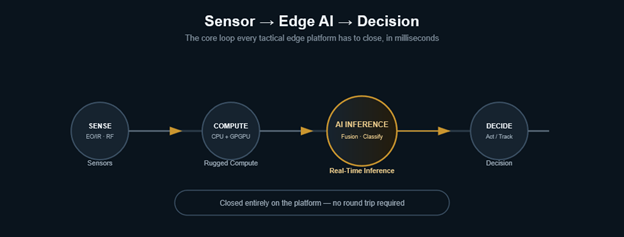
Modern military platforms are no longer simply collecting information. They are becoming intelligent operational nodes responsible for filtering, processing, and analyzing massive volumes of data in real time.
Several industry trends are accelerating this transition:
- Increasing sensor resolutions and throughput
- AI-assisted mission systems
- Autonomous and semi-autonomous platforms
- Distributed battlefield operations
- Electronic warfare and RF-intensive environments
- Real-time ISR and sensor fusion requirements
These operational demands require embedded computing systems capable of delivering high-performance processing within compact and rugged SWaP-constrained deployments.
Why Traditional Computing Architectures Are No Longer Enough
Legacy defense computing architectures were largely designed around centralized processing models. While effective for earlier operational requirements, these systems struggle to meet the demands of modern tactical environments.
Latency and Delayed Decision-Making
Transmitting large volumes of sensor data to centralized infrastructure introduces delays that can reduce operational responsiveness.
Bandwidth Limitations
Modern ISR systems generate enormous amounts of data, creating significant pressure on communication networks and satellite links.
Contested and Disconnected Environments
Defense systems increasingly operate in denied or degraded communications environments where network access cannot always be guaranteed.
Increased Integration Complexity
Traditional distributed processing architectures often require additional infrastructure, increasing system complexity and lifecycle costs.
These limitations are driving defense organizations toward edge-native architectures capable of delivering intelligence directly where operational data is generated.
Rugged Edge Computing for Mission-Critical Environments
Deploying AI-enabled workloads at the tactical edge introduces significant engineering challenges. Unlike commercial data centers, military systems must operate reliably under harsh environmental conditions including:
- Shock and vibration
- Wide temperature extremes
- Power instability
- Dust and moisture exposure
- Airborne and mobile deployments
At the same time, aerospace and defense platforms continue demanding lower SWaP-C (Size, Weight, Power, and Cost) requirements without sacrificing computing capability.
This combination of environmental resilience and high-performance processing is accelerating the adoption of rugged modular embedded computing systems.
The Role of AI and Accelerated Computing
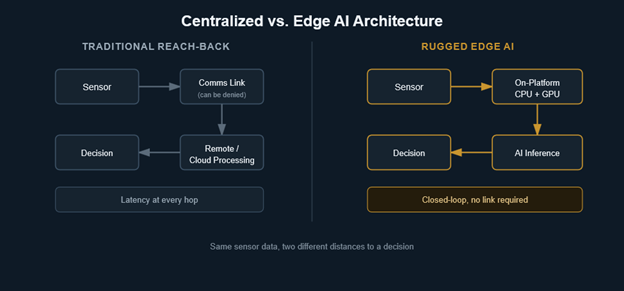
Modern defense workloads increasingly rely on AI acceleration and parallel processing architectures to support real-time operational intelligence.
Typical edge AI workloads include:
ISR and Sensor Fusion
Combining EO/IR imagery, radar feeds, telemetry streams, and RF data into actionable situational awareness.
AI-Assisted Threat Detection
Enabling rapid classification and identification of operational threats in real time.
Autonomous Navigation
Supporting intelligent navigation and obstacle avoidance for unmanned systems.
Electronic Warfare and RF Analysis
Accelerating signal processing and threat identification in contested electromagnetic environments.
These compute-intensive workloads require significantly greater processing capability than traditional embedded CPU architectures alone can efficiently provide.
Enabling Tactical Edge Intelligence with VNX+ Architectures
As defense platforms evolve, modular open architectures are becoming increasingly important for scalability, interoperability, and lifecycle flexibility.
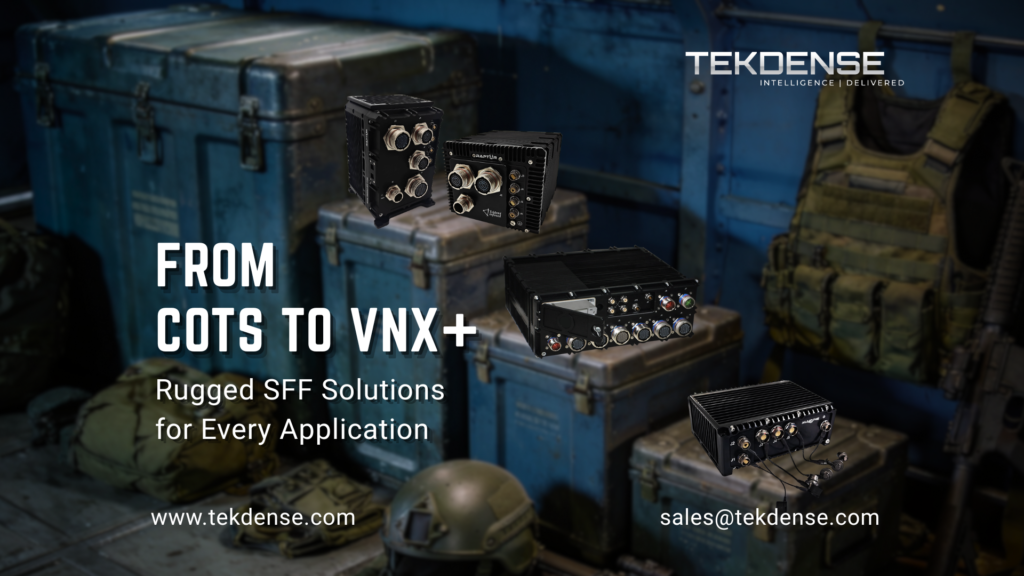
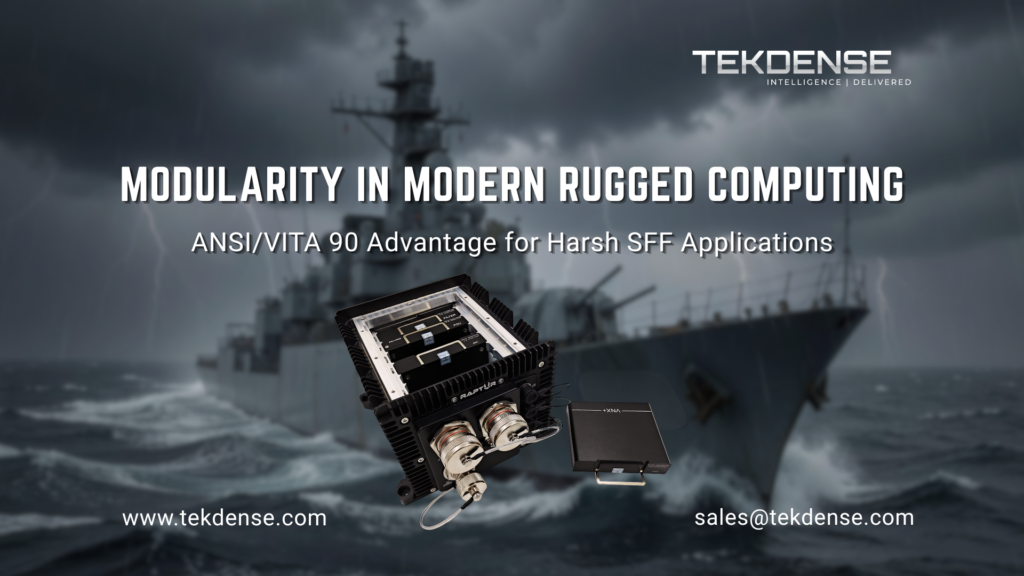
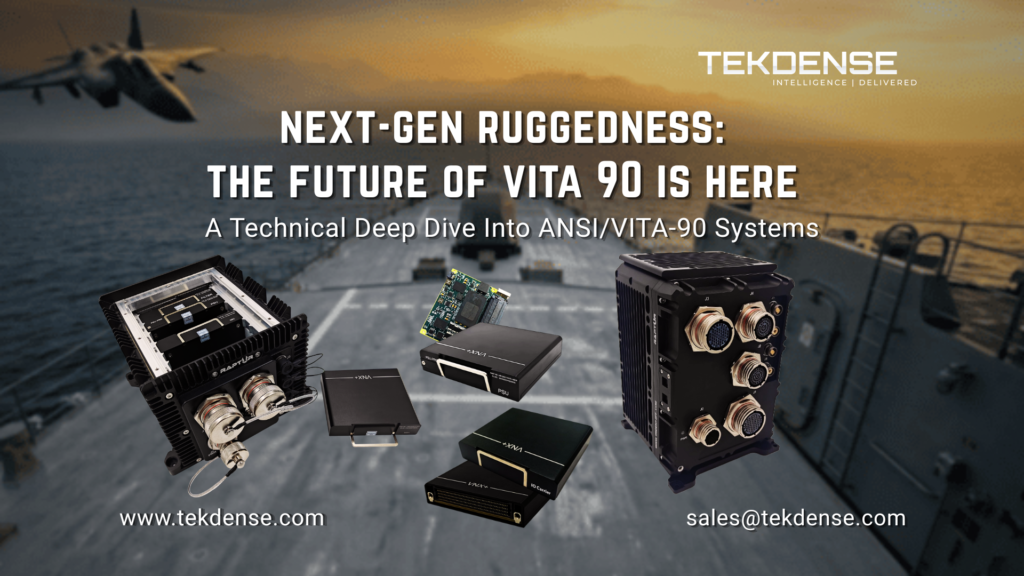
The VNX+ (VITA 90) ecosystem provides a compact modular architecture specifically designed for rugged embedded aerospace and defense applications. The architecture enables CPU, GPU/GPGPU, power, networking, and I/O Plug-In Modules (PIMs) to operate within a standardized backplane architecture optimized for SWaP-constrained deployments.
This modular approach supports:
- Faster technology refresh cycles
- Simplified integration
- Flexible mission customization
- Reduced vendor lock-in
- Improved scalability for evolving mission requirements
The VITA 90 standards family also aligns with the growing industry adoption of MOSA-inspired architectures for future defense systems.
Raptor-X5: Modular Tactical Edge Intelligence in Action
Platforms such as the Raptor-X5 demonstrate how rugged modular architectures are enabling next-generation tactical edge computing capabilities for aerospace and defense applications.
Built around the VNX+ ecosystem, the Raptor-X5 integrates CPU, GPU/GPGPU, power, EMI filtering, and energy storage modules within a compact rugged architecture optimized for mission-critical deployments.
The system supports flexible processing configurations including Intel® SBCs and NVIDIA® Jetson Orin NX GPU/GPGPU modules for AI and machine learning acceleration at the edge.
Key capabilities of the Raptor-X5 platform include:
- Compact 5-slot VNX+ architecture
- MOSA-inspired modular design
- GPU/GPGPU acceleration support
- Rugged construction for harsh environments
- SWaP-optimized deployment
- High-performance embedded processing
- Support for AI/ML workloads
- Flexible payload and I/O integration
The modular architecture allows the platform to support a broad range of tactical edge applications including ISR processing, AI-assisted mission systems, sensor fusion, RF analysis, and autonomous operational environments.
Accelerating Development with the TJ3 VNX+ Test Bench
As edge AI and rugged modular architecture continues evolving, rapid prototyping and validation platforms are becoming increasingly important.
The TJ3 VNX+ Test Bench provides an open-frame development environment for integrating and evaluating VNX+ CPU, GPU/GPGPU, power, and I/O modules during early-stage development and system validation.
This enables engineering teams to:
- Prototype VNX+ systems rapidly
- Evaluate AI and GPU acceleration modules
- Validate thermal performance
- Test PCIe and I/O integration
- Accelerate development timelines
- Reduce integration complexity
Development platforms such as the TJ3 help streamline the transition from benchtop evaluation to deployable rugged systems.
The Future of Tactical Edge Intelligence
The defense industry is rapidly moving toward distributed intelligence architectures capable of processing and acting on mission data directly at the edge.
Future aerospace and defense systems will increasingly depend on:
- Real-time AI inference
- Autonomous mission systems
- Distributed sensor fusion
- AI-assisted operational awareness
- Edge-native computing architectures
- Modular open systems
As operational demands continue evolving, rugged edge computing platforms will become foundational components of next-generation defense infrastructure.
Conclusion
Modern defense missions require more than traditional embedded computing. They demand intelligent, rugged, and scalable architectures capable of transforming raw sensor inputs into real-time operational decisions.
The rise of Tactical Edge Intelligence reflects a broader industry transition toward distributed AI-enabled computing optimized for harsh and SWaP-constrained operational environments.
By combining modular VNX+ architectures, AI acceleration, rugged deployment capability, and high-performance edge computing, platforms such as the Raptor-X5 are helping redefine how mission-critical intelligence is delivered at the tactical edge.
As aerospace and defense systems continue evolving, Tactical Edge Intelligence will play an increasingly critical role in enabling faster, smarter, and more resilient mission operations.
Build Your Next Tactical Edge Computing Platform
From AI-enabled ISR and sensor fusion to autonomous systems and RF-intensive applications, modern missions require computing architectures built for performance, ruggedness, and scalability at the edge.
Explore how Tekdense rugged VNX+ platforms can help accelerate your next-generation aerospace and defense computing requirements.
→ Explore the Raptor-X5
→ Explore VNX+ Rugged Computing Solutions
→ Talk to a Tekdense Engineer