Modular Ethernet Switch: Managed L2/L3 Switching for VNX+ Systems
Most engineers evaluating a VNX+ platform spend their time on compute modules and I/O carriers. The switch module gets treated as a commodity — something you select last, configure once, and forget about. That assumption tends to hold right up until a program hits a timing conflict, a network loop kills communications, or a topology change leaves a node unreachable.
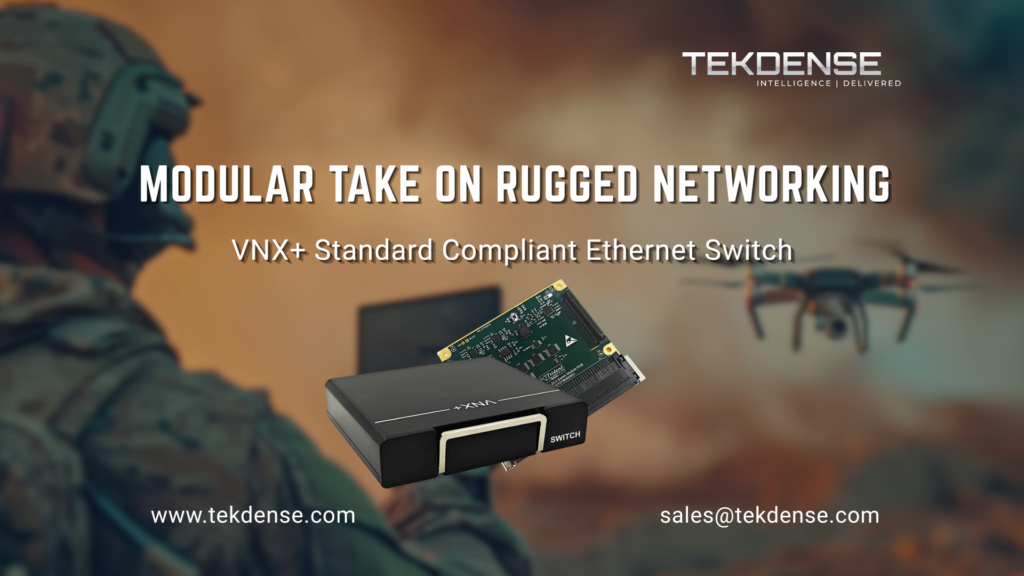
The VNX+ Ethernet Switch (Netspyder VX) was not designed to be forgotten. It was designed to be the most quietly capable module in your modular system—carrying the managed switching, dynamic routing, precision timing, and control that the rest of your system depends on, in a footprint of compact footprint.
If you’re an embedded hardware engineer, a defense program manager, or someone in the aerospace, defense, and industrial automation section, this article is your ultimate resource to learn more about the VNX+ ethernet Switch.
The Networking Core: Not Just a Switch
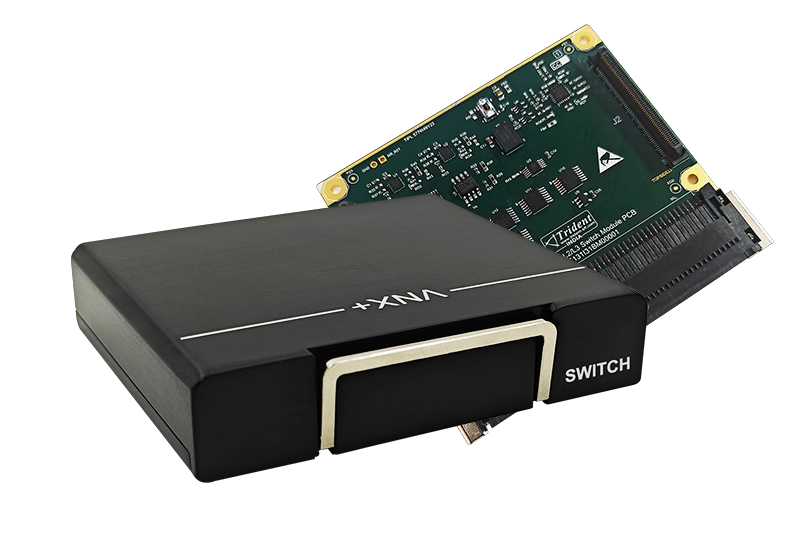
A conventional switch forwards data to ports. A networking core manages the communication fabric—enforcing traffic policy, maintain timing accuracy, routing between ports, and making networking decisions as per the operational requirements.
The Netspyder VX operates as a managed L2/L3 module and is fully compliant with ANSI VITA 90.0-2026. Its role inside a VNX+ system is to connect every other module through a standardized 400-pin Searay interface. It absorbs all I/O, power, management, and timing signals through a single connector, without external cabling or hardware.
Switching Feature Set (Layer 2)
The L2 switching feature set of the Netspyder VX is built for the scale and complexity that defense and aerospace programs actually encounter—not just textbook topologies.
- MAC address and VLAN capacity: The module supports 8,000 MAC address entries and 4,000 VLANs as per IEEE 802.1Q. This capacity supports large, embedded network environments where traffic management is crucial.
- Multicast management: Up to 8,000 IPv4 and IPv6 multicast groups are supported simultaneously. In applications where multiple modules connect to the same data streams like sensor fusion architectures, for example —multicast group management prevents unnecessary traffic issues across various paths.
- Jumbo frames: Frame sizes are supported at all speeds (10/100/1000 Mbps), which is important in high-throughput data transfer scenarios.
- Link aggregation: The Netspyder VX supports flexible link aggregation based on Layer 2 through Layer 4 traffic classification.
- Storm control and flooding control: Multicast, broadcast, and flooding control mechanisms are all implemented, which prevent any one traffic type from overwhelming switch capacity during network errors.
- Spanning tree: RSTP and MSTP ensure loop-free operation across redundant network topologies.
- QoS: Eight priority levels with eight queues per port and per-queue scheduling enable control while bulk data transfers run in background queues.
Routing Feature Set (Layer 3)
Here is where the Netspyder VX earns its position as a networking core rather than a basic module.
Static IPv6 routing runs in both hardware and software, enabling data forwarding without deploying an external gateway in the chassis. For fixed embedded architectures, this eliminates an entire module slot and the associated SWaP overhead.
OSPFv2 per RFC 2328 brings dynamic route distribution to the VNX+ system, forwarding data and updating it automatically.
IEEE 1588 Precision Time Protocol is built in at the switch level. In a VNX+ system with multiple processing modules generating time-stamped data, the PTP keeps everything synchronized to an accurate time.
RADIUS accounting along with Port and queue policers round out the L3 feature set, providing port traffic enforcement that prevents the data from saturating the switch.
Port and Interface Architecture
The Netspyder VX delivers the following physical interface configuration:
8 × GigE Ports (10/100/1000 Mbps) via MDIO management. Three QSGMII ports support optional expansion modules, enabling either 8 or 12 additional ports per expansion card for a maximum system port count of 24.
Two 10GbE SFI uplink ports are provided in dual configurations: 400-pin connector with zero-aperture (electrical), or 320-pin with half-aperture supporting MT optical interfaces. One RS232 Console port also supports network management.
Supported Applications
The Netspyder VX is suitable for deployment in onboard avionics networks, aerospace and defense embedded computing platforms, industrial automation, and CubeSat systems. Its combination of L2/L3 managed switching, 10GbE uplinks, IEEE 1588 PTP, and VITA 90 compliance makes it an ideal switching module for programs requiring standards-compliant, rugged, scalable Ethernet fabric.
Explore Rugged Ethernet Switches for VNX+ Applications
Reach out to us for VITA-90 compliant ethernet switching requirements for reliable networking in the field.