
How Are Modular I/O Carriers Changing Embedded System Design
Embedded computing platforms are increasingly expected to do more than process data — they need to connect to a growing mix of sensors, buses, and peripheral devices without adding unnecessary size or complexity to the system. As mission and industrial computing architectures evolve, the ability to add I/O functionality on demand, rather than redesigning a system from scratch, has become an important design consideration.
This is the kind of challenge a modular I/O carrier is built to address. It’s a high-speed PCIe connectivity module designed to extend the I/O capabilities of a host system through a modular, expansion-based approach. In this blog, we’ll look at why I/O flexibility matters, why it needs a dedicated carrier, and how that carrier is built, configured, and where it fits in real world deployments .
Why Modular I/O Expansion Matters
Modern embedded systems are rarely built around a single fixed I/O configuration. Different deployments call for different combinations of interfaces — analog signals, digital I/O, serial communication, or specialized data buses — and building a dedicated board for every combination isn’t practical.
An I/O carrier approach solves this by separating the core computing platform from the I/O layer. Instead of committing to one fixed set of interfaces, system designers gain access to a range of I/O modules that can be matched to what a given application requires. This kind of modularity is particularly valuable in demanding computing applications, where flexibility and scalability directly affect how easily a system can be adapted or reused across projects.
Understanding VNX+
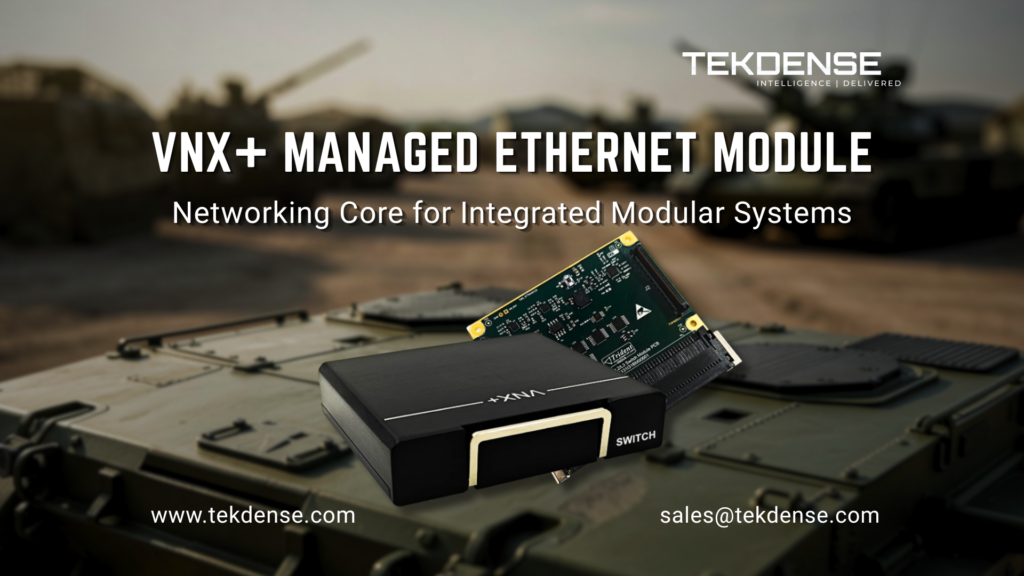
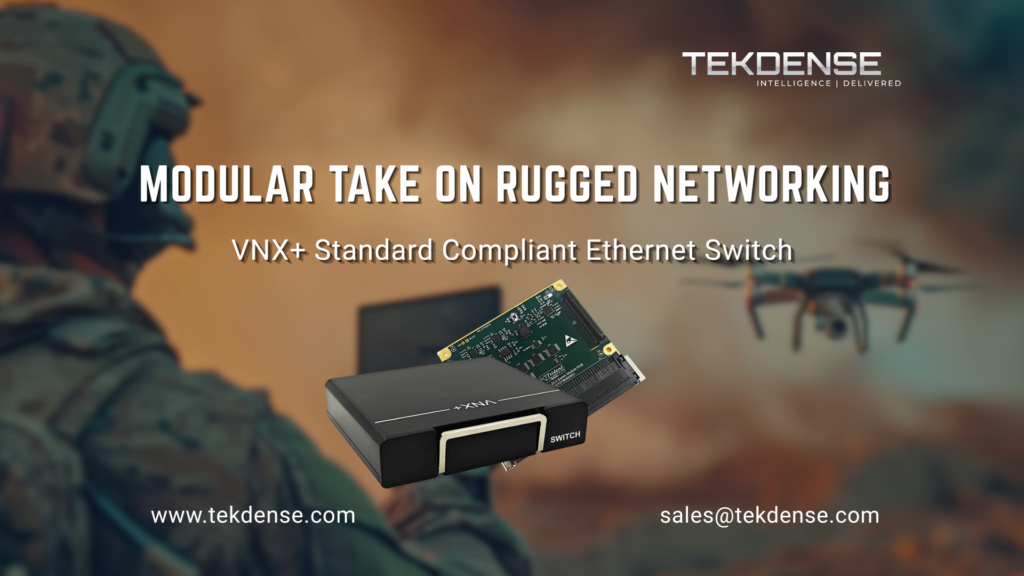
VNX+ systems are built around this kind of architecture. VNX+, also known as VITA 90, is an open embedded computing standard for small-form-factor, rugged, modular computing systems built around a 19 mm module. Its modular backplane lets functional modules — power supply, compute, GPU/AI acceleration, I/O, and networking — be inserted, removed, and replaced independently, which is a major reason VNX+ has gained traction in defense, aerospace, and industrial computing.
Because compute and connectivity are separate modules in this architecture, a VNX+ system relies on a dedicated I/O Carrier Module to link it to external devices and peripherals.
What Is the VNX+ I/O Carrier?
The VNX+ I/O Carrier is a high-speed PCIe connectivity solution built to provide seamless integration between a VNX+ system and a range of external devices and peripherals. Rather than fixing I/O functionality at the board level, the carrier acts as an interface point that accepts industry-standard miniPCIe /Acropack® modules.
Because it supports two of these modules simultaneously, the carrier allows a single VNX+ system to be configured with a varied mix of I/O functionality — including ADC, DAC, digital I/O, serial ports, 1553, and ARINC429 — simply by selecting the appropriate miniPCIe or Acropack® card. This turns I/O expansion into a configuration decision rather than a hardware redesign.
Standards and Architecture
The VNX+ I/O Carrier connects into the system using a standard PCIe interface that follows ANSI VITA 90, which serves as the VNX+ Base Standard. Building the carrier around this standard interface means it integrates into the VNX+ ecosystem in a defined, predictable way, giving system designers a known interconnect to work with when planning system architecture.
The carrier communicates with its miniPCIe / Acropack® modules through dedicated interfaces, which is what enables the modular I/O expansion from ADC to ARINC429. This combination — a standardized system-level connection paired with configurable module interfaces — is central to how the carrier balances system-level consistency with application-level flexibility.
Features That Enable Flexibility
Flexibility is central to how the VNX+ I/O Carrier is built, and it comes down to a small set of core features:
| Feature | At a Glance |
| Expansion Slots | 2 slots, each Full or Half miniPCIe / Acropack® |
| I/O Functionality Supported | ADC, DAC, digital I/O, serial ports, 1553, ARINC429 |
| I/O per Slot | 48 pins |
| I/O Routing | Routed per slot to a 200-pin Searay connector |
| Dimensions | 3.5 x 3.07 x 0.75 in |
| Weight | 0.55 lbs |
| Operating Temperature | -40°C to +85°C |
Applications
The VNX+ I/O Carrier’s configurable slots make it a fit for systems that need to add or change I/O functionality without a hardware redesign:
- H3: Scalable I/O expansion — for demanding computing applications where interface needs evolve over time
- H3:Data conversion — systems that need configurable ADC, DAC, or digital I/O functionality
- H3:Serial communication — applications requiring dedicated serial port connectivity
- H3:Bus interface connectivity — systems that rely on 1553 or ARINC429 data buses
Conclusion
At its core, the VNX+ I/O Carrier solves a simple problem: it lets engineers add and change I/O capability without redesigning the whole system. With two configurable expansion slots, it can support a wide range of I/O needs — from ADC and DAC to serial communication and data bus interfaces like 1553 and ARINC429 — all in a compact, rugged package built to work across a wide temperature range.
Explore VNX+ I/O Solutions from Tekdense
Want to learn more about what’s available and discuss your specific requirements? Reach out to our team at sales@tekdense.com.