Rugged SFF Computers for Tactical Edge Missions: A Complete Guide
Modern defense, avionics, and industrial automation programs are advocating for a single architectural truth: compute has to move to where the mission happens, not the other way around. Defense, aerospace, and industrial programs can no longer wait for data to be hauled back to a server room. This is the operating reality behind rugged SFF Computing for Tactical Edge deployments—small, conduction-cooled, mission-ready systems that bring processing, networking, and AI inference directly into harsh, space-constrained environments.
This article walks through a family of rugged Small Form Factor (SFF) platforms—from the palm-sized rugged SFF computers through the fully modular VNX+ platforms.
What “Tactical Edge” Actually Demands
Before comparing platforms, it’s worth establishing what separates tactical edge computing from a standard industrial embedded box. Across every platform discussed in this article, four engineering constraints repeat:
Size, Weight, and Power (SWaP)
The tactical edge demands compact, rugged, lightweight systems with low power consumption across any terrain or conditions.
Conduction cooling
Every system in this lineup is fanless and conduction-cooled, which eliminates a major failure point in dusty, vibration-heavy, or sealed environments.
Wide operating temperatures
Most platforms operate from -40°C to +55°C as standard, extending to +71°C with assisted airflow for various missions.
MIL-STD compliance
MIL-STD-810H, MIL-STD-461G/F, MIL-STD-704D and MIL-STD-704F/1275E recur across the SFF computers, reflecting design for avionics, defense, and industrial automation sectors.
What changes from platform to platform is size, processing core, I/O density, and modularity — and that’s where mission-specific selection comes in.
Rugged Nano SFF: Kestrel for Ultra-Constrained Payloads
At the smallest end sits the Kestrel platform, built around an Intel module and a NVIDIA Jetson Orin-accelerated module—with I/O’s connected through a compact Micro-D 100-pin connector.
Intel Processor-Based
It runs a 7th Gen Intel Atom (8C, 1.30 GHz) with 16 GB of LPDDR5 RAM and onboard eMMC storage from 32 GB up to a 64GB to 512GB build option via M.2 SATA or NVMe (PCIe x2 lane).
I/O on this SFF computer includes a display port, USB 2.0, USB 3.2 Gen 1, Gigabit Ethernet, RS232 serial ports, GPIOs, and audio, with an optional mPCIe expansion adding 20 more I/Os.
NVIDIA Jetson Orin NX-Based
The GPU swaps the Intel processor for a NVIDIA Jetson Orin NX with an integrated Ampere GPU and Arm Cortex-A78AE processor, paired with 16 GB LPDDR5 and 256 GB NVMe storage. Its I/O set mirrors the SBC module but substitutes two CSI interfaces.
Both Kestrel modules accept +18VDC to 32VDC input. The Intel module operates from -40°C to +55°C, while the GPU module’s range narrows to -20°C to +55°C, reflecting the thermal headroom needed by the Orin NX.
Rugged Micro SFF: Magpie Series for Compact Processing
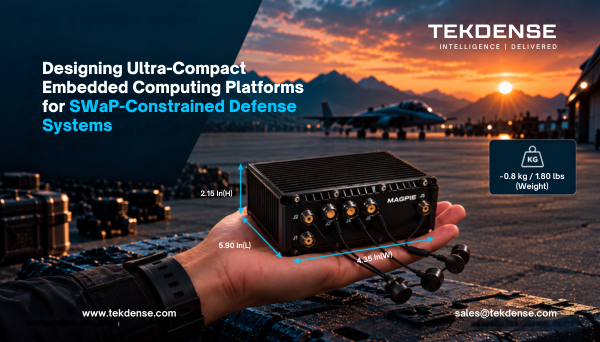
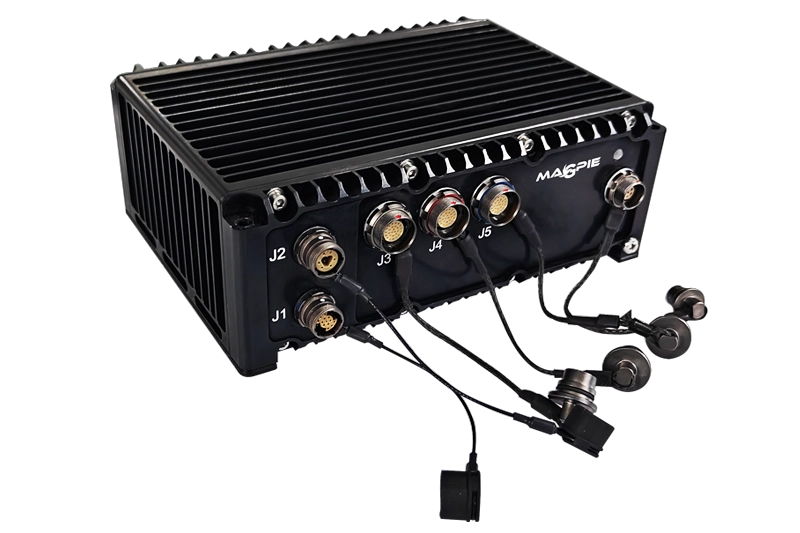
One step up in footprint is the Magpie series, available in two processor variants sharing a common 5.90 x 4.35 x 2.15 inches chassis and ~1.80 lbs weight.
Magpie A
This is built on a 7th Gen Intel Atom with 16 GB LPDDR5 RAM, Intel UHD Graphics, and onboard eMMC (32 GB standard, 64GB–512GB MLC/SLC expansion). It supports AI-adjacent workloads through Intel DL Boost, AVX2 with INT8 support, and OpenVINO. Power draw is rated at 20–25 Watts at 28 VDC, and compliance follows MIL-STD-810F, MIL-STD-461F, and MIL-STD-704F/1275D.
Magpie T
It swaps in an 11th Gen Intel Core i7 for workloads needing real-time performance, while keeping the same 16 GB LPDDR4 memory ceiling and 64GB–512GB expansion storage range. Power draw rises slightly to 20–30 Watts under the same 28 VDC input and compliance profile as Magpie A.
Both variants offer a standard I/O set of Gigabit Ethernet, USB 3.2, 2 USB 2.0, audio, serial ports (RS232/422/485), and GPIOs, with expansion through mPCIe/AcroPack sites.
Rugged Mini SFF: Lanius Series for Mid-Tier Embedded Compute
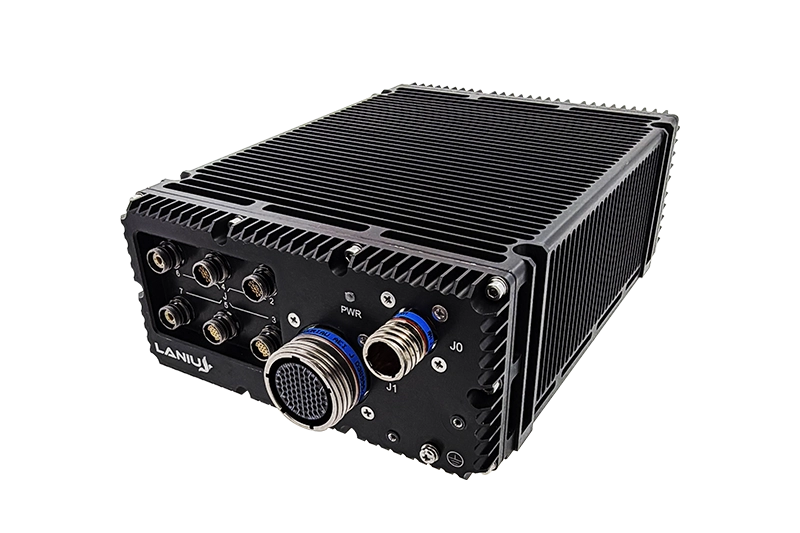
The Lanius series steps up to a 6.40 x 8.5 x 2.95 inches, ~5.2 lbs chassis built on the COMe architecture.
Lanius R
The Lanius R runs on a 13th Gen Intel Core i7 processor with up to 64 GB DDR5 RAM and up to 1980GB of M.2 SATA/NVMe storage, paired with Iris Xe integrated graphics.
Lanius T
It uses an 11th Gen Intel Xeon (8C/16T) at the same memory and storage ceilings, aimed at real-time, data-intensive workloads.
Standard I/O across both variants includes Gigabit Ethernet port, USB 3.2, USB 2.0, HD audio, RS232 (full mode)/RS422/RS485 ports, a dedicated RS232 console port, and GPIOs—all on MIL-Circular connectors.
Power draw is 40–60 Watts at 28 VDC, operating temperature spans -40°C to +55°C (up to +71°C with assisted airflow), and compliance covers MIL-STD-461G, MIL-STD-704F/1275E, and MIL-STD-810H.
The Lanius series suits C5ISR and HPEC applications that need COM Express-class processing without compromising power.
Mid-to-Large Rugged SFF: Falcon, Osprey, and the Case for Hybrid COTS
Where Kestrel, Magpie, and Lanius address constrained installs, the Falcon and Osprey platforms scale up to deliver higher I/O density, larger memory ceilings, and broader expansion without abandoning the conduction-cooled, MIL-connector designs.
Rugged Hybrid COTS: Falcon R and Falcon T
The Falcon series is built on open COM Express (COMe) architecture in an 8.55 x 10.25 x 4.33 inches, ~10.60 lbs chassis, available with two processor options.
Falcon R uses a 13th Gen Intel Core i7, while Falcon T uses an 11th Gen Intel Xeon. Both share up to 64 GB DDR5 RAM, up to 1980GB M.2 SATA storage, and Iris Xe integrated graphics.
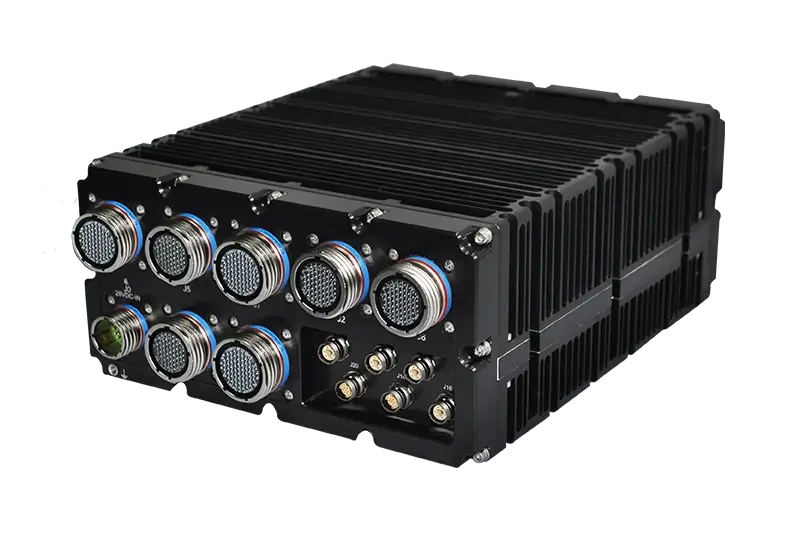
Standard I/O includes 1 Gigabit Ethernet ports, USB 3.2, USB 2.0, HD audio, RS232/RS422/RS485 ports, a console RS232 port, and GPIOs.
Where Falcon distinguishes itself is expansion density: MiniPCIe/AcroPack sites (1 PCIe each) plus a single XMC site (PCIe x8, VITA 42 compliant). This combination of COTS components with XMC expansion and MIL-STD-1553B/ARINC-429-capable I/O sites is what positions Falcon as a hybrid COTS platform.
Power draw is 45–80 Watts at 28 VDC, with the same -40°C to +55°C (up to +71°C assisted) range and MIL-STD-461G/704F/1275E/810H compliance.
Rugged Scalable SFF: Osprey for High-Density Expansion
The Osprey platform pushes I/O scalability further, in a larger 11.80 x 4.55 x 10.65 inches, ~16.5 lbs chassis built around a 13th Gen Intel Core i7 processor with up to 64 GB DDR4 RAM, up to 1980GB M.2 SATA storage, and Intel UHD graphics controller.
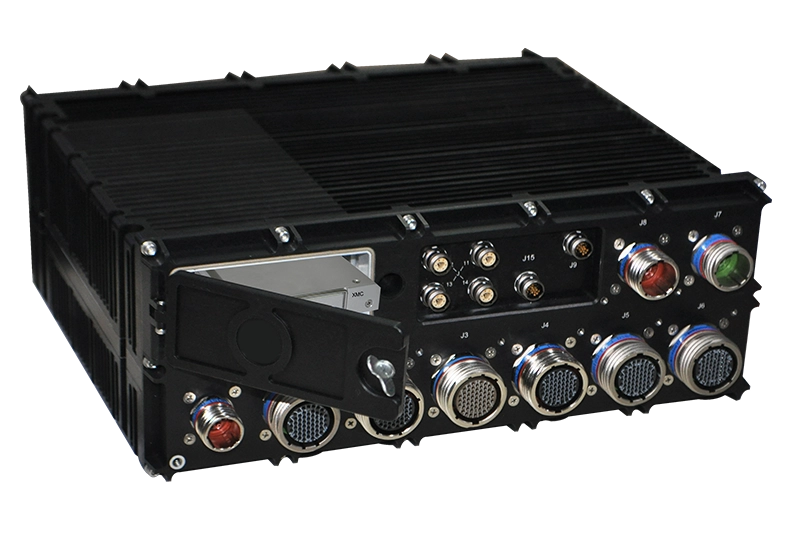
What sets Osprey apart is its expansion topology: five MiniPCIe/AcroPack sites and two XMC sites. Standard I/O includes 1 Gigabit Ethernet, USB 3.2, USB 2.0, audio in/out, RS232/RS422/RS485 ports, and GPIOs, with build options for dual 10G Ethernet, a removable storage drive, system health monitoring & control, and TPM 2.0 security.
Power consumption sits at 50–90 Watts at 28 VDC, the highest in the non-modular lineup, reflecting its role as a high-performance, scalable embedded computer for applications that need more expansion slots than Falcon offers. Operating range and compliance match the rest of the SFF family.
Rugged AI SFF: Willet-O for AI Inference at the Edge
Willet is purpose-built around AI throughput as the primary design driver. Built on the NVIDIA Jetson AGX Orin Industrial platform, it pairs an Arm Cortex-A78AE CPU with an integrated Ampere GPU offering up to 2048 CUDA cores and 64 Tensor Cores, delivering up to 275 TOPS (INT8), an 8x performance increase.
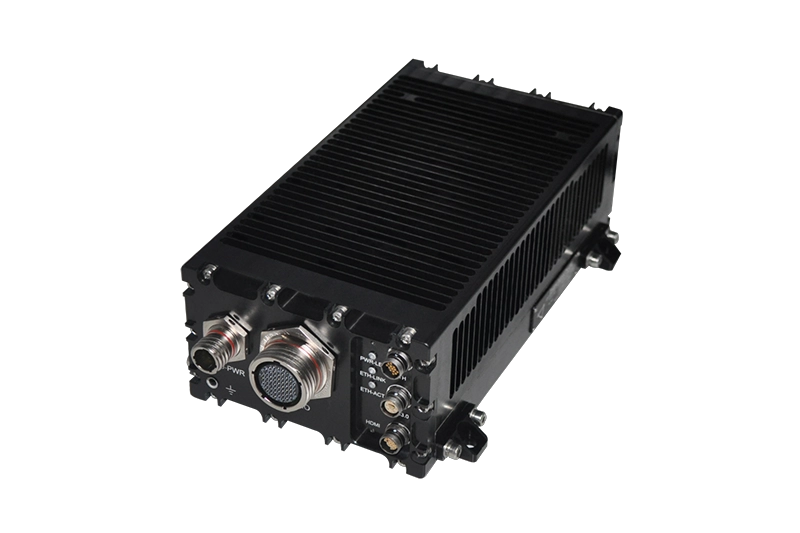
It carries 64 GB LPDDR5 DRAM and 64GB eMMC 5.1 Flash storage, with I/O expansion through mPCIe slots and M.2 slots (one for NVMe SSD, one for additional I/O cards). Standard interfaces include USB 3.0, USB 2.0, RS232/RS422/RS485 ports, 1GbE port, 10GbE copper ports, GPIOs, CAN interfaces, audio, and a debug serial console.
In a 6.10 x 2.90 x 910 inches, ~5.50 lbs chassis, Willet supports NVIDIA Linux-For-Tegra (L4T) based on Ubuntu OS. Power draw is under 65W at 28 VDC, with -40°C to +55°C (up to +71°C assisted) operating range and MIL-STD-461G, MIL-STD-704D, and MIL-STD-810H compliance.
Modular VNX+ Architectures: When the Mission Outgrows Configuration-Dependant SFF
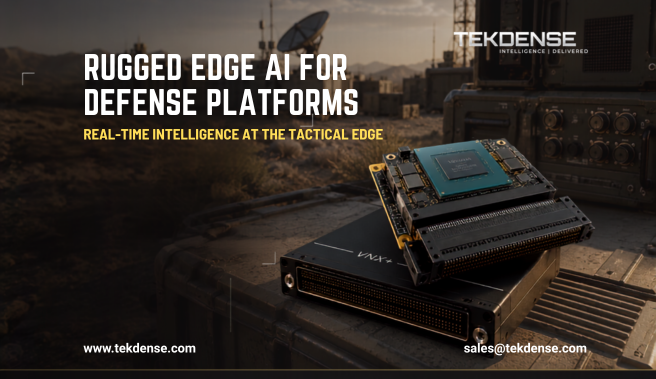
Some tactical missions require swapping compute, GPU, PSU or networking modules in the field as requirements evolve. This is the gap addressed by VNX+ (ANSI VITA-90) compliant modular systems.
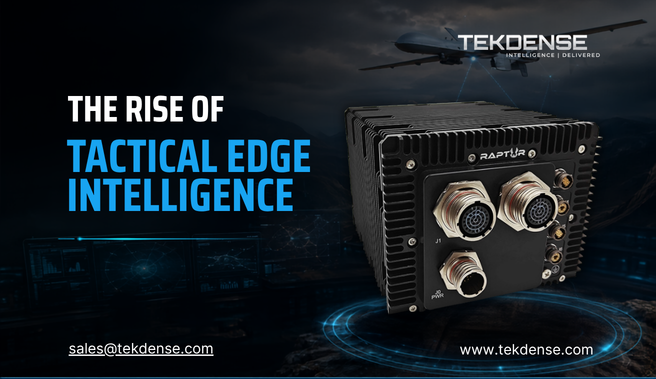
5-Slot VNX+ System: Raptor X5
Raptor X5 is organized around a five-slot backplane. Its module set includes a VNX+ EMI filter, a VNX+ PSU module, a holdup module, a GPU module, and an SBC module built on an Intel 11th Gen i7 processor (16 GB RAM, 64GB upto 256 GB NVMe).
Combined I/O includes display ports, USB 3.0, USB 2.0, RS232, 1GbE, and GPIO, mapped through Fischer and 38999 connectors.
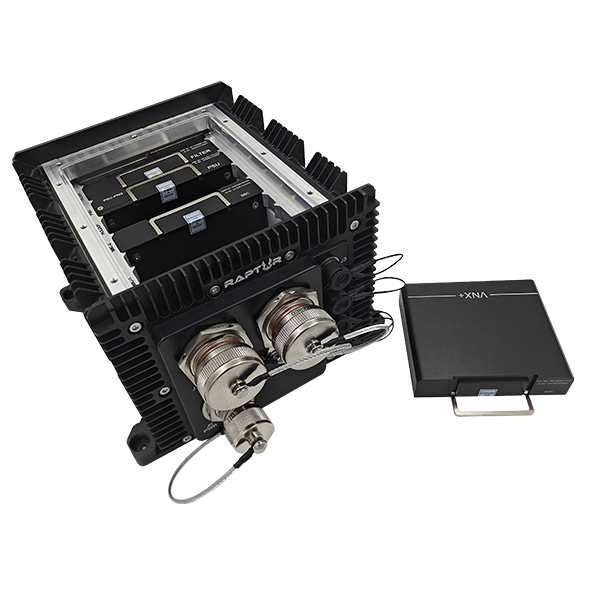
In a 7.00 x 4.80 x 6.85 inches, ~8.1 lbs chassis, Raptor X5 operates at -40°C to +55°C without the integrated GPGPU module, narrowing to -20°C to +55°C when the GPU module is present—both extending to +71°C with assisted airflow.
Compliance covers MIL-STD-461G, MIL-STD-704F/1275F, and MIL-STD-810H.
7-Slot VNX+ System: Raptor X7
Raptor X7 extends the same VNX+ philosophy across a seven-slot backplane supporting compute, I/O, and power modules. Additional modules include: an integrated Ethernet switch module and a dedicated I/O carrier module.
The remaining slots mirror Raptor X5’s architecture: PSU, EMI filter, GPGPU module, holdup module, and SBC module. Total system Ethernet capability reaches ten Gigabit ports, alongside display ports, USB 3.0, USB 2.0, RS232.
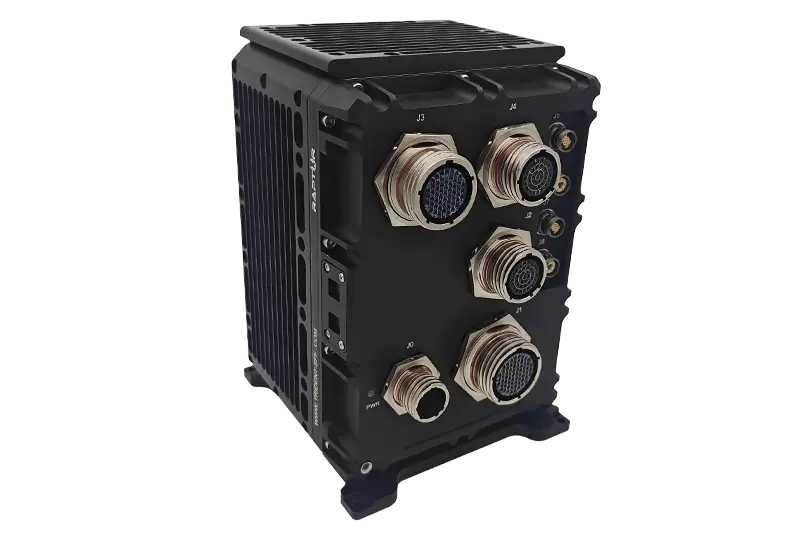
Raptor X7 shares Raptor X5’s dual operating temperature profile (-40°C to +55°C without GPGPU, -20°C to +55°C with it integrated, both extending to +71°C assisted) and the same MIL-STD-461G, 704F/1275F, and 810H compliance baseline.
Each platform in this lineup — Kestrel, Magpie, Lanius, Falcon, Osprey, Willet, and the Raptor X5/X7 VNX+ systems — represents a distinct combination of footprint, processor, I/O, and modularity, all built around the same non-negotiable foundation of conduction cooling, MIL-grade connectors, and SWaP, and wide-temperature operation.
Explore Tekdense’s Full Range of Rugged SFF Solutions
Reach out to our team for specific SFF configurations or VNX+ modular systems for your mission requirements. Contact us at sales@tekdense.com or +1 305-317-3646